

What is the role of audit and its effectiveness? What is the added-value to the business?
With the new TKK, the concept of “internal audit” became more common in the business world. In the face of expanding business and transaction volume, business managers; ‘planning’, ‘organizing’, ‘executing’, coordinating and ‘control’ by applying the management functions determined. Control is the last of the management functions and provides an evaluation on the result of the application of the previous functions.
The control function is fulfilled by the internal control system established in the enterprise. In order to provide internal control, an internal audit chart must be created. Companies need an audit element apart from their internal control activities, so the internal audit function gains importance.
From this point of view, let’s look at the main topics of what is internal auditing, its role and effectiveness on companies.
What is Internal Audit?
Internal audit is the business’s control to provide services to the business.
It can be defined as an independent evaluation function created within the enterprise to examine and evaluate the transactions.
According to Article 63 of the Internal Audit, Public Financial Management and Control Law; Internal auditing is an independent, objective assurance and consulting activity conducted to evaluate whether the resources are managed in accordance with the principles of economy, effectiveness and efficiency in order to add value and improve the work of the public administration, and to provide guidance.
Who is the Internal Auditor?
It is a professional person who provides consultancy and assurance services to the management with a professional approach in order to realize the objectives of the institution and to use its resources effectively, economically and efficiently.
What is the Purpose of Internal Audit?
Internal audit helps the organization achieve its objectives by bringing a systematic and disciplined approach to evaluate and improve the effectiveness of risk management, control and governance processes.
The purpose of internal audit is to improve the activities of the organization and add value to them.
The main focus is to improve the process!
What is the Difference of Internal Audit?
It is carried out with modern techniques and tools instead of traditional methods.
- It is planned on a risk-based basis.
- Written rules have universal standards.
- It is future oriented, not past oriented.
- It is carried out according to strategic priorities.
- It is systematic and continuous.
- Provides objective assurance.
- Objective and Independent.
- Covers all types of inspection
What Is Looked At In Internal Audit And How Is It Done?
Internal audit activity; It covers compliance, performance, financial, information technology and system audit applications.
Planning process in internal audit; defining the audit universe, identifying audit areas, defining risk criteria and grading risks, prioritizing audit areas, allocating audit resources, preparing and approving the internal audit plan and program.
Each internal audit activity;
- Planning,
- Conducting the audit,
- It consists of reporting and monitoring process.
What are the Types of Internal Audit?
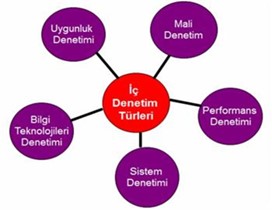
a) Compliance audit: It is the examination of the compliance of the activities and transactions of public administrations with the relevant laws, regulations, regulations and other legislation.
b) Performance audit: It is the evaluation of the effectiveness, economy and efficiency in the planning, implementation and control of the activities and transactions carried out at all levels of the management.
c) Financial audit: The accuracy of the accounts and transactions regarding income, expenses, assets and liabilities; Evaluating the reliability of financial systems and statements.
d) Information technology audit: It is the evaluation of the continuity and reliability of the electronic information systems of the audited unit.
e) System audit: The activities of the audited unit and the internal control system; It is to analyze the organizational structure with a contributing approach, to identify its deficiencies, to investigate its quality and suitability, and to evaluate the adequacy of the resources and applied methods.
What Internal Audit Brings to Businesses
- It ensures that the risks that can be unpredictable and that may cause devastating results within the enterprise are determined beforehand and the necessary prevention studies are carried out and the negativities that may arise from such negativities are minimized.
- It monitors whether operations are carried out effectively and beneficially in accordance with the procedures, standards, instructions and policies of the enterprise.
- It ensures the prevention of losses caused by mistakes and frauds in the business.
- Gives assurance. It plays a role in ensuring the company’s prestige and confidence in the financial statements with its internal audit studies. It enables the business to take advantage of the opportunities in the internal and external environment. It is ensured that the institutionalization of the enterprise is developed and the reputation of the enterprise is increased.
- The need to provide reliable information is met. It will make it easier for parties who want to learn about the business to access reliable information. It helps the management to make healthier decisions by providing accurate information.
- The need to increase productivity is met; In this context, inefficient activities can be eliminated if internal audit works effectively.
- Supports the company’s resilience to economic, financial and real sector crises. By guaranteeing the integrity and efficiency of the capital and funds of the enterprise, it ensures that measures are taken to protect them against internal and external risks and that suggestions are developed.
- The need to protect business assets and records is met. In the presence of an effective internal audit system, the assets and records of the enterprise are highly protected.
- Ensures the compliance of the business with the laws and regulations to which it is subject. Internal Audit provides reasonable assurance on matters required by law and regulation.
- Compliance with the policies determined by the senior management is ensured. The compliance of business activities and projects with the plan and budget targets of the organization is ensured. It ensures compliance with the rules set within the enterprise.
- Evaluation of management performance is provided. With internal auditing, you will be informed about the success of the management in realizing the company’s goals.
- It ensures that the internal controls of the enterprise are maintained in a healthy way. Internal control by providing self-control contributes to the efficient operation of the system.
Corporate Risk Management-Internal Audit Relationship? Why is it Important for Businesses?
Enterprise risk management provides more insight into the future of the company, while internal audit provides a great deal of retrospective.
In the internal audit activity, there are some formulated and detailed recommendations regarding the determination of corporate risk structures.
In corporate risk management, on the other hand, it involves revealing how the company actually does what it does in an existing structure, how effective these are on the results, how important these results can be, and associating them with the results they have had in the past.
It is a guidance, assurance and consultancy activity that aims to make corporate risk management, governance and internal control mechanisms systematic and sustainable. Therefore, internal audit and enterprise risk management serve the same purpose.
Monitoring of audit results
In processes such as corporate transformation, committees such as internal audit must be attached to the board of directors.
Project proposals, determined in terms of corporate risk,It is necessary to monitor the extent to which the places identified in the non-compliance test of the control system have improved.
Internal audit’s duty is to establish systems that will make a difference in terms of the overall operation of the company, but when the question of how to understand that internal audit makes a difference, the “monitoring of audit results” section is used as an answer.
In the results; Systemically, continuous improvement and development is determined as the target.
As İ&G Accounting, we are always with you to respond to the needs of our valued clients.